
Affiliate disclosure: TeckAtlas is reader-supported. If you buy through links on this page, we may earn a commission at no extra cost to you. Learn more.
This air purifier buying guide explains the numbers that matter, so you can pick the right purifier for your room. With air quality in many Indian cities regularly reaching unhealthy levels, especially in winter, an air purifier has become an essential appliance for many homes. But numbers like CADR, H13 and “coverage area” can be confusing. Here is what they mean and how to choose.
1. CADR: the most important number
CADR (Clean Air Delivery Rate) tells you how much filtered air the purifier delivers, usually in cubic metres per hour (m³/h). A higher CADR cleans a room faster. As a rough rule, choose a purifier whose CADR is at least 4 to 5 times your room’s volume per hour for polluted conditions.
Example: a 150 sq ft bedroom with a 10 ft ceiling is about 42 cubic metres, so a CADR of roughly 170 to 210 m³/h or more is a good target.
2. Room size and coverage claims
Manufacturers’ coverage figures are often optimistic. It is safer to buy a purifier rated for a larger room than you have, and run it on a lower, quieter speed.
3. Filters
- True HEPA (H13 where possible): captures very fine particles, including PM2.5. This is the filter that matters most.
- Activated carbon: helps reduce odours, smoke and some gases.
- Pre-filter: traps hair and large dust, extending the HEPA filter’s life. A washable pre-filter saves money.
Be cautious of vague terms like “HEPA-type” or “HEPA-like”, which may not meet true HEPA standards.
4. Running costs
Replacement filters typically need changing every 6 to 12 months, depending on pollution and usage. Check the price and availability of replacement filters before you buy, because over a few years they can cost more than the purifier itself.
5. Useful features
- PM2.5 sensor and AQI display: shows your indoor air quality in real time.
- Auto mode: adjusts fan speed based on air quality.
- Sleep mode: low noise and dimmed lights for bedrooms.
- Filter-change indicator: tells you when to replace filters.
- App control: nice to have, but not essential.
6. Things to avoid
Avoid purifiers that rely mainly on ionisers or that produce ozone, as ozone can irritate the lungs.
How to choose an air purifier for each room
Different rooms need different priorities. Use this part of the air purifier buying guide to match features to the room you want to clean.
Bedroom
Look for low noise in sleep mode, a display you can dim or switch off, and enough CADR to clean the room several times an hour while you sleep.
Living room
Larger, open spaces need a higher CADR. A PM2.5 sensor with auto mode helps, because the purifier speeds up when cooking smoke or outdoor pollution drifts in.
Children’s or elderly family members’ rooms
Prioritise quiet operation, a child lock and an auto mode, so the purifier responds to changes in air quality without anyone needing to adjust it.
Home office
A compact model with the right CADR for the room is usually enough. App control is useful if you want to switch it on before you start work.
If you are still deciding how to choose an air purifier, start with your room size and the CADR you need, then add features one by one. Knowing how to choose an air purifier this way keeps you from paying for extras you will rarely use.
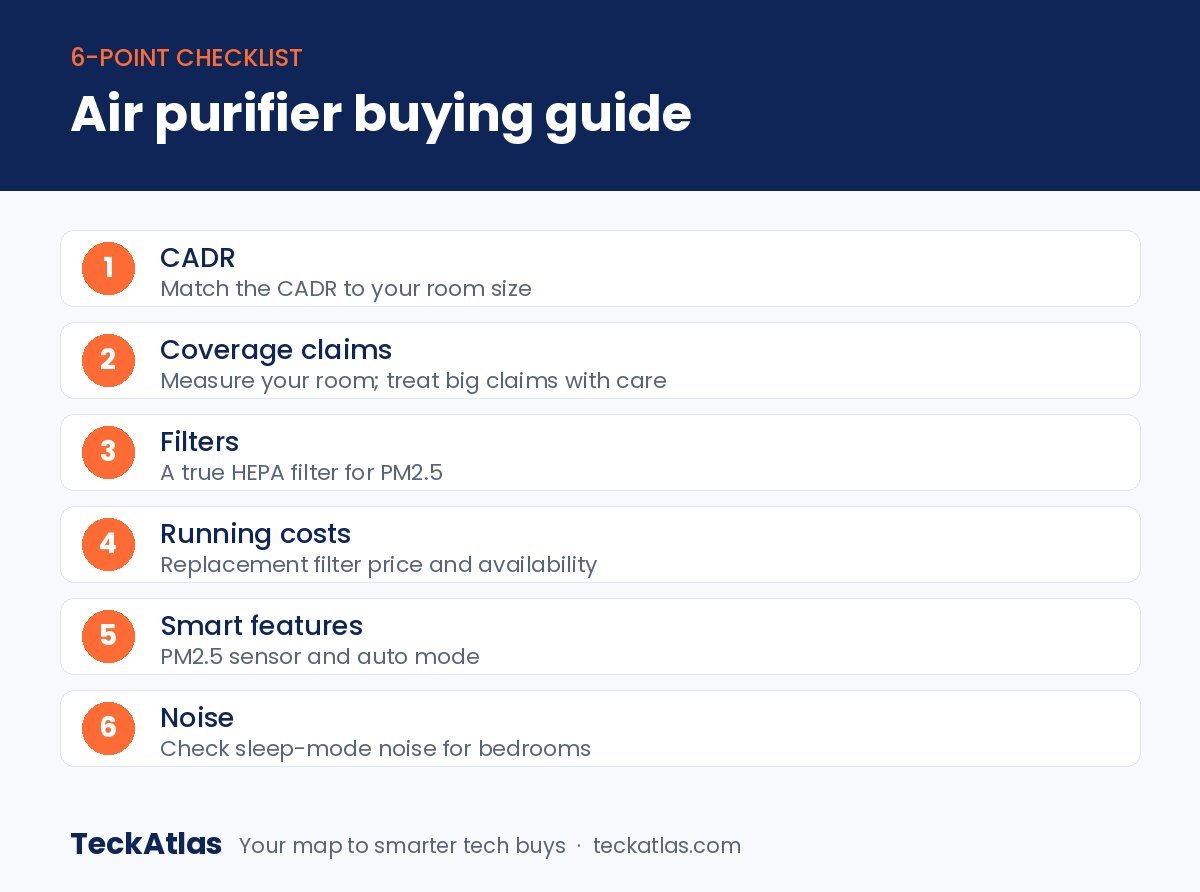
Save this air purifier buying guide and the checklist above for the next time pollution levels rise. A good air purifier buying guide should help you compare models quickly, especially during sales when prices change every day.
Air purifier buying guide: quick checklist
- Measure your room and calculate the CADR you need.
- Look for a true HEPA filter (H13 where possible).
- Check replacement filter cost and availability.
- Look for a PM2.5 sensor and auto mode.
- Check noise levels if it is for a bedroom.
Ready to buy? See our picks for the best air purifiers for Indian winters, chosen using this checklist. We hope this air purifier buying guide helps you choose the right model for your room.
Frequently asked questions
How do I choose the right air purifier size?
Calculate your room volume and choose a purifier whose CADR is at least 4 to 5 times that volume per hour. When in doubt, pick a model rated for a larger room and run it at a lower speed.
Do air purifiers really help with pollution?
Yes. Purifiers with a true HEPA filter remove most fine particles, including PM2.5, from the air that passes through them. Keep doors and windows closed for the best results. You can check air quality data on the Central Pollution Control Board website.
How much does it cost to run an air purifier?
Most purifiers use relatively little electricity. The bigger ongoing cost is replacement filters, which typically need changing every 6 to 12 months.
Where should I place an air purifier?
Place it where air can flow freely around it, away from walls and furniture, ideally in the room where you spend the most time, such as the bedroom.

