

Affiliate disclosure: TeckAtlas is reader-supported. If you buy through links on this page, we may earn a commission at no extra cost to you. Learn more.
Wondering how to choose the right mixer grinder for your kitchen? A mixer grinder is probably the hardest-working appliance in an Indian kitchen. It grinds masalas, makes chutneys, whips up batter and blends juices, often several times a day. Choosing the wrong one means a motor that overheats, jars that leak or blades that struggle with whole spices. This guide explains what actually matters.
1. Motor power: how many watts do you need?
- 500W: fine for small families with light use, such as chutneys, juices and occasional dry grinding.
- 750W: the sweet spot for most homes. Handles daily wet and dry grinding, including idli and dosa batter.
- 1000W and above: worth it for large families or heavy grinding of hard spices, turmeric and large batches.
Higher wattage alone does not guarantee better results; blade design and jar shape matter too. But an underpowered motor will overheat quickly with heavy use.
2. Jars: number, size and material
Most mixer grinders come with three or four jars. A typical set includes a large wet-grinding jar, a medium dry-grinding jar, a small chutney jar and sometimes a juicer jar. Look for stainless steel jars with sturdy handles and leak-proof lids with good gaskets.
3. Speed settings and pulse
Three speeds plus a pulse or “whip” function is standard. Pulse is useful for coarse grinding and for controlling texture in things like coconut chutney.
4. Safety and durability features
- Overload protection: cuts power if the motor overheats, protecting it from burning out.
- Copper motor winding: generally runs cooler and lasts longer than aluminium.
- Ventilation: good airflow keeps the motor cool during long grinding sessions.
- Stable base: rubber feet or suction bases reduce vibration and noise.
- Certification: check for the ISI mark from the Bureau of Indian Standards (BIS) on the product or packaging.
5. Warranty and service
Look for at least two years of warranty on the product, and ideally five years on the motor. Before buying, check that the brand has an authorised service centre in your city, since jar couplers and blades eventually need replacing.
How to choose the right mixer grinder for your household
The right model depends on who you cook for and what you grind most. Use this mixer grinder buying guide as a shortcut once you know your daily routine.
Small families and couples
A 500W to 750W mixer with three jars covers chutneys, masalas and occasional batter. Prioritise a compact body and a good small chutney jar, since that is the jar you will use most.
Families of four or more
Go for a 750W motor with a large wet jar of around 1.5 litres. Bigger batches of idli and dosa batter need the extra capacity and a motor that does not overheat halfway through.
Heavy grinding and dry masalas
If you grind whole spices, turmeric or large quantities of batter every week, look at 1000W models with strong overload protection and good ventilation. For very large batter batches, a dedicated wet grinder may still be the better tool.
Juices and smoothies
Choose a model with a juicer jar or blender attachment only if you will use it regularly. Otherwise, the extra jar adds cost and takes up cupboard space.
Common mistakes to avoid
The most common mistake is buying on wattage alone. A mixer grinder buying guide is only useful if you also check the jars, the blades and the service network near you. Another mistake is ignoring noise: if you cook early in the morning, read owner reviews about sound levels. Finally, do not pay extra for jars you will never use. Knowing how to choose the right mixer grinder is mostly about matching the machine to your kitchen, not buying the biggest number on the box.
Whichever group you fall into, the steps for how to choose the right mixer grinder stay the same: match the motor to your workload, the jars to your recipes and the warranty to how long you plan to keep it. Save the checklist below and keep this mixer grinder buying guide handy when you compare prices.
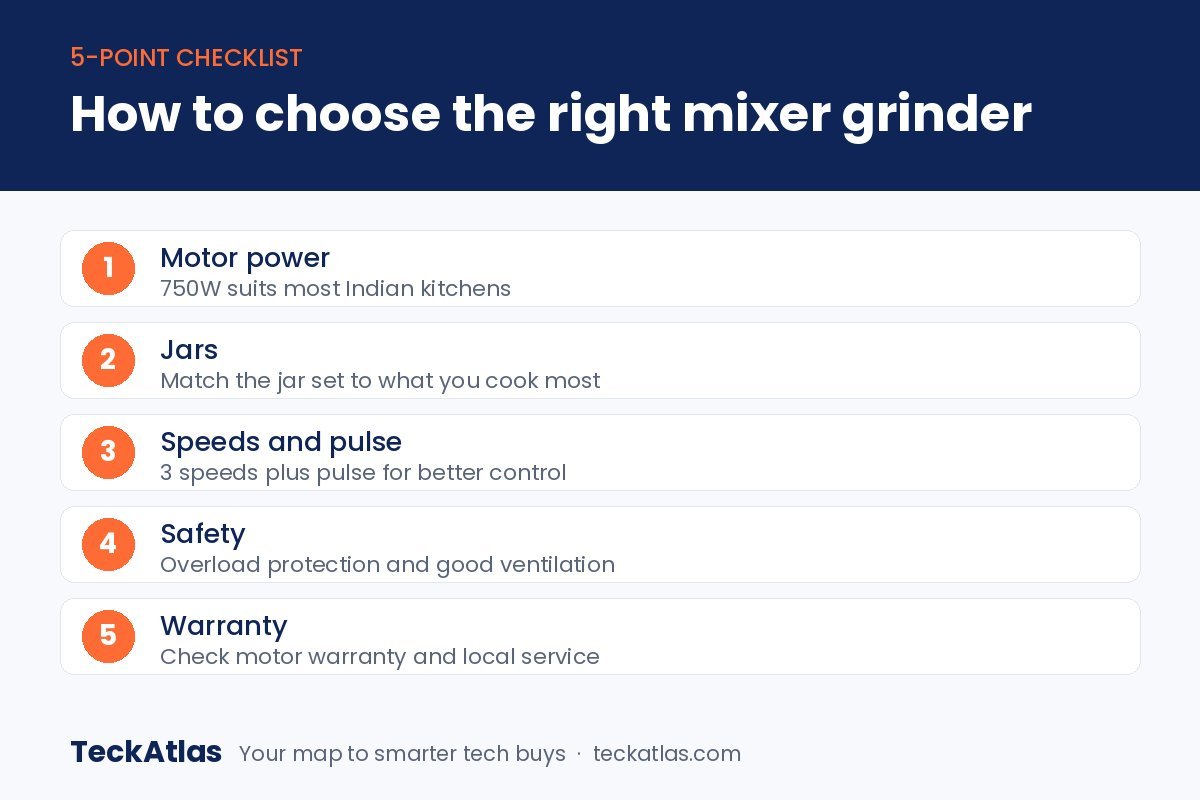
Still unsure? Our mixer grinder buying guide recommends starting with a 750W, three-jar model from a brand with good local service. It suits most Indian kitchens, and it is the simplest answer to how to choose the right mixer grinder if you cook a mix of chutneys, masalas and batter.
How to choose the right mixer grinder: quick checklist
- Choose 750W unless you have a specific reason to go lower or higher.
- Make sure the jar set matches what you cook most.
- Confirm overload protection and good ventilation.
- Check motor warranty and local service availability.
- Compare prices across retailers and watch for sale offers.
Ready to buy? See our picks for the best mixer grinders under ₹5,000, chosen using this checklist. Now that you know how to choose the right mixer grinder, you can compare models with confidence.
Frequently asked questions
How do I choose the right mixer grinder for daily use?
Start with a 750W motor, three stainless steel jars, overload protection and at least two years of warranty. Then check that the brand has a service centre in your city.
Is 1000W better than 750W?
A 1000W motor handles heavy, frequent grinding and large batches more comfortably. For most families, a good 750W mixer grinder is enough and costs less.
Which jar is used for idli and dosa batter?
The largest wet-grinding jar, usually around 1.5 litres, is designed for batter. Grind in batches and add water gradually for a smooth texture.
Should I buy a mixer grinder with a juicer jar?
Only if you make fresh juice often. A juicer jar with a filter is handy, but three jars cover almost all Indian cooking.
How long does a mixer grinder last?
With regular care, a good mixer grinder can last several years. Avoid overloading the jars, let the motor rest between batches and replace worn couplers and blades when needed.