Snapdragon vs Dimensity is one of the most common questions Indian phone buyers ask, and you will see both names on almost every phone listing. Qualcomm makes Snapdragon chips and MediaTek makes Dimensity chips, and between them they power most Android phones sold in India. So which is better?
Quick answer: Neither brand is better across the board. In the Snapdragon vs Dimensity debate, what matters is the exact chip model and its tier, not the brand name. A mid-range Dimensity 7400 beats an entry-level Snapdragon 4s Gen 2, and a Snapdragon 7s Gen 4 beats an entry-level Dimensity 6300. Compare chips from the same tier, then look at the phone’s cooling, software and update promise.
This explainer breaks down how both families are named, which chips compete with each other in 2026, and the real-world differences that matter for gaming, battery life and cameras. We have not run our own benchmarks; this guide is based on official chip specifications and widely published test results.
Snapdragon vs Dimensity: who makes them?
Qualcomm’s Snapdragon chips are designed in the United States, and MediaTek’s Dimensity chips are designed in Taiwan. Both use CPU designs based on Arm, and most of their recent chips are manufactured by TSMC. That is why, in the same price range, their everyday performance is often very close.
Historically, MediaTek was seen as the budget option, but that changed with the Dimensity range. Today MediaTek competes at every level, from ₹10,000 phones to flagships, and in India it powers more budget and mid-range phones than any other chip maker.
How to read the chip names
Snapdragon naming
- Snapdragon 4 series: entry level, for example the Snapdragon 4s Gen 2.
- Snapdragon 6 series: budget to lower mid-range, for example the Snapdragon 6s Gen 4 and 6 Gen 3.
- Snapdragon 7 series: mid-range, for example the Snapdragon 7s Gen 4.
- Snapdragon 8 series: premium and flagship, for example the Snapdragon 8s Gen 4 and 8 Elite Gen 5.
- An “s” after the number usually means a slightly cut-down version of the main chip in that series.
Dimensity naming
- Dimensity 6000 series: entry level, for example the Dimensity 6300 and 6400.
- Dimensity 7000 series: mid-range, for example the Dimensity 7300 and 7400.
- Dimensity 8000 series: upper mid-range, for example the Dimensity 8450 and 8500.
- Dimensity 9000 series: flagship, for example the Dimensity 9500.
- Words like Ultra, Apex, Max or Pro after a Dimensity name are usually special editions made for one phone brand. They are mostly the same chip with small tuning changes, so a Dimensity 7400 Ultra performs very close to a regular Dimensity 7400.
Snapdragon vs Dimensity: which chips compete in 2026
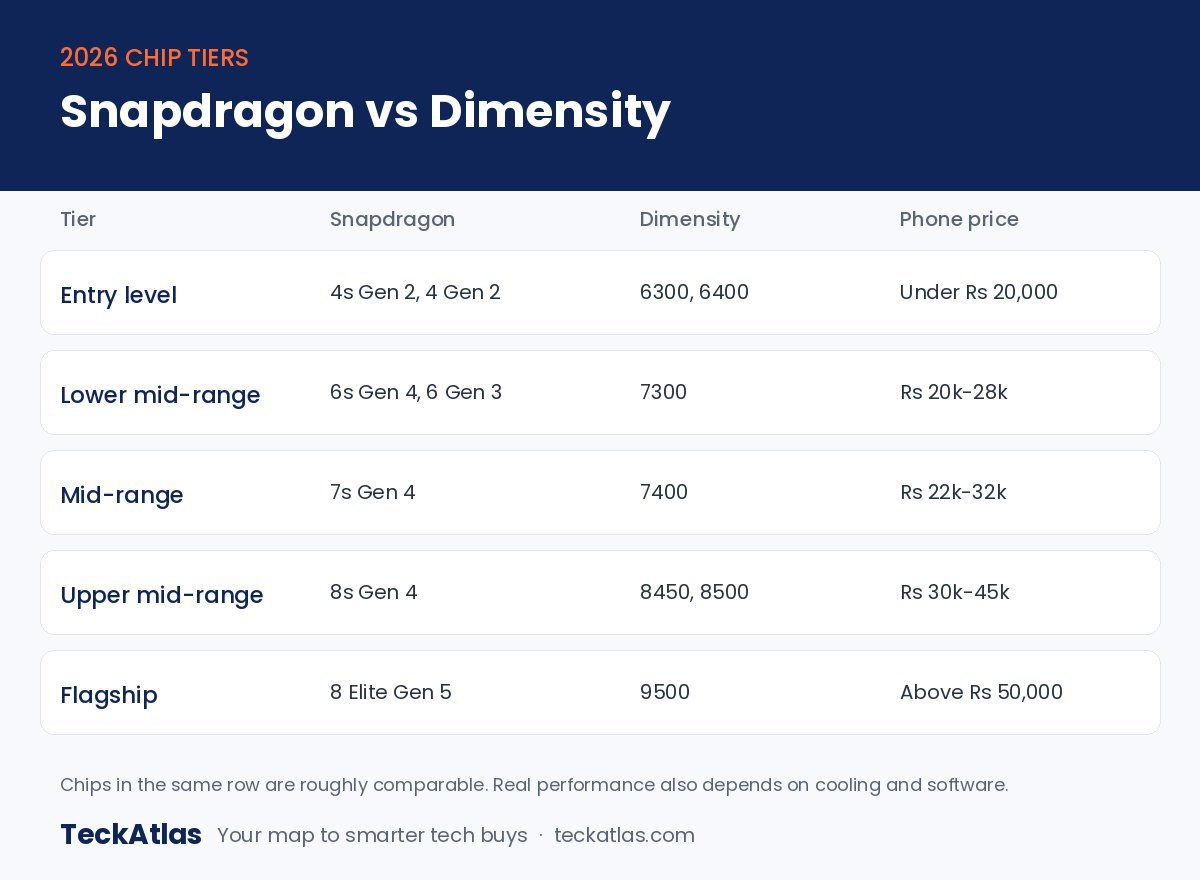
The table below groups chips that are roughly comparable in each tier. Exact performance varies by phone, because cooling and software tuning make a big difference.
| Tier | Snapdragon | Dimensity | Typical phone price |
|---|---|---|---|
| Entry level | Snapdragon 4s Gen 2, 4 Gen 2 | Dimensity 6300, 6400 | Under ₹20,000 |
| Lower mid-range | Snapdragon 6s Gen 4, 6 Gen 3 | Dimensity 7300 | ₹20,000–₹28,000 |
| Mid-range | Snapdragon 7s Gen 4 | Dimensity 7400 | ₹22,000–₹32,000 |
| Upper mid-range | Snapdragon 8s Gen 4 | Dimensity 8450, 8500 | ₹30,000–₹45,000 |
| Flagship | Snapdragon 8 Elite Gen 5 | Dimensity 9500 | Above ₹50,000 |
Real-world differences that matter
Everyday speed
For WhatsApp, YouTube, UPI payments, Instagram and browsing, chips in the same tier feel almost identical. In practice, RAM, storage speed and how clean the software is often matter more than Snapdragon vs Dimensity for everyday smoothness.
Gaming
Snapdragon chips use Qualcomm’s Adreno graphics, and many game developers optimise for them, so Snapdragon phones sometimes get higher frame-rate options in popular games and better support for emulators. In recent Snapdragon vs Dimensity comparisons, Dimensity chips have closed much of this gap and often deliver more raw performance for the same price. For serious gaming, sustained performance matters most: how well a phone holds its speed after 20–30 minutes without overheating, which depends on the phone’s cooling as much as on the chip.
Battery life and heating
In Snapdragon vs Dimensity battery comparisons, efficiency depends mainly on how the chip is made. A 4nm chip usually runs cooler and uses less power than a 6nm chip, whichever brand made it. The Dimensity 7400 and Snapdragon 7s Gen 4 are both 4nm chips, while the Dimensity 6300 is a 6nm chip. Battery size and software tuning also make a big difference.
Cameras
Both companies build an image signal processor (ISP) into their chips. In the mid-range, camera quality depends far more on the sensor, OIS and the phone maker’s software than on the Snapdragon vs Dimensity choice. Our list of the best camera phones under ₹30,000 includes both chip brands.
5G and connectivity
On 5G, Snapdragon vs Dimensity makes little difference. Both families support the 5G bands used in India, including n78 and n28. Network performance depends more on the phone’s antenna design and your local signal than on the chip brand.
Snapdragon vs Dimensity: real examples from our lists
- Motorola Edge 70 Fusion (Snapdragon 7s Gen 4) vs realme P4x (Dimensity 7400 Ultra): both are 4nm mid-range chips with similar everyday performance. The realme is cheaper; the Motorola adds an AMOLED screen and IP69 protection.
- Redmi 15 5G (Snapdragon 6s Gen 3) vs Tecno POP X 5G (Dimensity 6400): both are entry-level chips best suited to everyday use and light gaming.
You can see these phones in our lists of the best phones under ₹30,000, the best 5G phones under ₹20,000 and the best phones under ₹15,000.
What about Exynos, Unisoc and Tensor?
- Exynos: Samsung’s own chips, used in many Galaxy phones. The Exynos 1380 in the Galaxy M36 is a capable mid-range chip.
- Unisoc: budget chips used in some phones under ₹15,000, such as the Unisoc T8300. They are fine for basic use but slower than Dimensity 6000-series chips.
- Tensor: Google’s chips for Pixel phones, focused on AI and camera processing rather than raw speed.
Verdict: Snapdragon vs Dimensity, which should you choose?
Do not choose a phone by chip brand alone. In the Snapdragon vs Dimensity question, the tier and model number matter far more. Here is a simple way to decide:
- Find the chip’s tier using the table above.
- Between two chips in the same tier, prefer the newer one and the one made on a smaller process (4nm over 6nm).
- If you are a serious gamer or use emulators, a Snapdragon chip in the same tier can be a slight advantage.
- If you want the most performance for your money, Dimensity phones often give more for the price.
- Finally, check the update promise, battery and display. Our guide on how to choose a smartphone covers all of these.
Frequently asked questions
Snapdragon vs Dimensity: which is better for gaming?
Within the same tier, Snapdragon often has slightly better game optimisation and emulator support, while Dimensity often offers more raw performance for the price. Cooling matters as much as the chip.
Is Dimensity better than Snapdragon for battery life?
Neither brand is always more efficient. Chips made on a 4nm process usually use less power than 6nm chips, whichever company designed them.
Is the Dimensity 7400 better than the Snapdragon 7s Gen 4?
They are close competitors made on the same 4nm process, and everyday performance is similar. Differences between phones come more from cooling, software and other hardware.
Does Dimensity heat more than Snapdragon?
Older MediaTek chips had that reputation, but recent Dimensity chips run about as cool as Snapdragon chips in the same tier. Heating depends a lot on the phone’s design.
What do Ultra, Apex and Max mean on Dimensity chips?
They are special editions made for particular phone brands. Performance is very close to the standard chip with the same number.
Should I avoid Unisoc chips?
Not necessarily. They are fine for calls, WhatsApp and YouTube, but if you can afford it, a Dimensity 6300 or 6400 phone will feel faster.